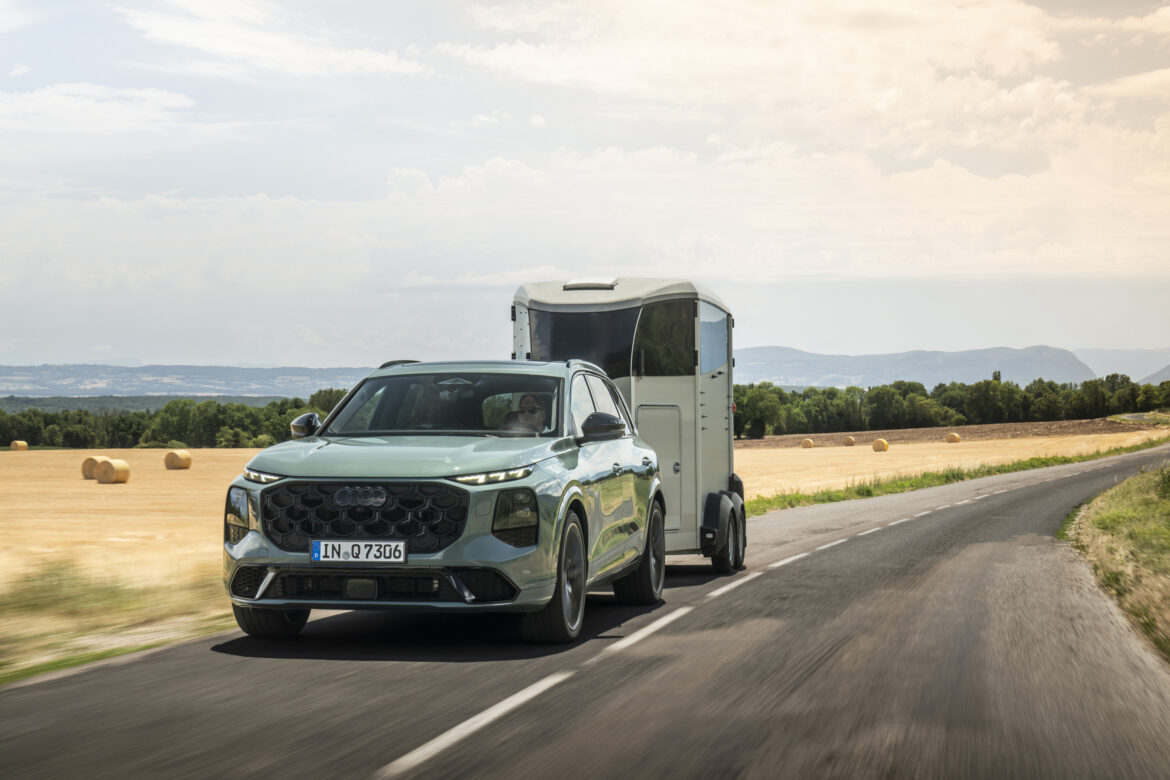
With the new Q7, Audi is building on a successful legacy in the SUV segment. The third generation of this model proves a companion – equally at home in a packed business schedule, on relaxed weekend getaways, or on long road trips. The Q7 claims to set the benchmark in spaciousness, driving dynamics, comfort, and technology. The same applies to the unmistakable exterior design with its powerful silhouette and expressive digital lighting technology.
Available with five, six, or seven seats, the Q7 delivers maximum versatility and everyday usability. Passengers will delight in its spacious interior, including an illuminated panoramic sunroof with switchable transparency. Power comes from a 3.0-liter V6 diesel engine producing either 220 kW (299 PS)1 or 180 kW (245 PS)2 with MHEV plus technology, including a powertrain generator that temporarily supplements the drivetrain with up to 18 kW (24 PS) of additional output. An electric-powered compressor also delivers strong starting performance. In Germany, prices for the Audi Q7 start at €87,900, while in Ireland it is over €120,000.
The Q7 comes standard with five seats. Two individual seats are also available as an option in the second row. Together with two seats in the third row, they transform the Q7 into a six-seater. The popular seven-seat layout also remains available as an option, allowing for the installation of three child seats. All seats are electrically adjustable. Another highlight in the top trim level is the large, illuminated panoramic sunroof with switchable transparency.
Storage compartments in the doors and in the new centre console add to the everyday practicality of the Audi Q7. The new centre console features expansive decorative trim and provides space to wirelessly charge two smartphones to Qi2.2 standard, along with extra-large cup holders. The five-seater has a trunk capacity of up to 806 litres. Folding down the second-row seats expands the storage space to up to 2,075 litres. The seven-seater offers up to 722 litres of luggage space behind the second row and a maximum volume of 1,980 litres behind the first row.
Lighting plays a special role in the look of the new Q7. The optional digital Matrix LED headlights with micro-LED modules are built on technology that can directly project high-resolution light patterns, opening up numerous possibilities for adaptive light distribution and lighting assistance. At the rear, third-generation digital OLED rear lights feature communication lighting and an active digital light signature. The Audi Q7 offers up to eight digital light signatures for the rear lights and headlights. The digital OLED panels, with more segments than in previous generations, enable captivating designs with three-dimensional effects in the rear light signatures. The projection light in the doors is a new feature. When the driver’s and front passenger’s doors are opened, a white rhombus unfurls, welcoming the passengers and lighting the path to the vehicle.
Audi is now integrating lighting functions in the Q7 series much more closely with driver assistance features. With the lane guidance or orientation lights, for example, important information from the assistance systems is displayed directly in the driver’s field of view ahead of the vehicle with a direct visual reference to the surroundings. These lighting features thus help to increase driving safety. The advanced turn signals are the first of their kind. At night, a stylized turn signal is projected onto the ground in sync with the dynamic signals at the front and rear. This quickly alerts other road users, such as cyclists, to a lane change or turn.
The model also offers various driving assistance functions – such as adaptive driving assistant plus, which supports the driver with acceleration, braking, speed and distance maintenance, and lane keeping. This makes driving more comfortable, especially on long journeys. The trained parking feature allows customers to teach the Audi Q7 individual parking manoeuvres. The new reverse assist helps when backing out of a dead-end street, for example.
At launch, the new Q7 (combined fuel consumption in l/100 km: 8.0–7.1; combined CO2 emissions in g/km: 209–186; CO2 class: G) will be available with a three-litre V6 diesel engine delivering 220 kW (299 PS)1 and 630 Nm of torque or 180 kW (245 PS)2 and 500 Nm. The three-litre V6 diesel engine with MHEV plus technology features an electric-powered compressor for direct throttle response.
The MHEV plus technology, including a next-generation powertrain generator, supports the drivetrain with up to 18 kW (24 PS) of extra power. The three-litre V6 diesel engine thus offers powerful starts and highly efficient driving. As standard, the Q7 is equipped with an eight-speed tiptronic and quattro permanent all-wheel drive with the new limited-slip centre differential with preload. Customers opting for the highest level of the classic quattro with a limited-slip centre differential benefit from improved traction and effortless steering response, an even more agile yet stable driving feel, and particularly precise handling – such as during rapid and sudden load changes.
The standard steel spring suspension ensures a superior driving experience. Optionally, adaptive air suspension or adaptive air suspension sport with controlled damping make the Q7 even more agile and versatile.
The new Q7 is built in Bratislava, just like the two previous generations.